Short answer. Folic acid is the synthetic form the body must convert before use. Methylfolate (5-MTHF) is the active form in blood. Folinic acid (calcium folinate, the drug leucovorin) is already reduced and skips the slow first step. The placebo-controlled autism trials used folinic acid (Frye 2018: 48 children, 12 weeks).
Folic acid, methylfolate and folinic acid at a glance
| Folic acid | Methylfolate (5-MTHF) | Folinic acid (calcium folinate) | |
|---|---|---|---|
| What it is | Synthetic, fully oxidized folate used in fortified flour and most multivitamins | The active form of folate that circulates in blood | A reduced folate; the same compound as the prescription drug leucovorin |
| Needs the DHFR enzyme first | Yes, and DHFR works slowly in humans | No | No |
| Route into the brain | Folate receptor alpha (after conversion) | Folate receptor alpha | Folate receptor alpha, and at higher doses the reduced folate carrier as well |
| US upper limit applies | Yes (1,000 mcg a day for adults) | No official limit or DFE factor | No official limit or DFE factor |
| Used in the autism trials | No | No | Yes: 21 studies, 4 of them placebo-controlled (Rossignol and Frye 2021) |
What is the difference between folic acid and folinic acid?
Folic acid is the cheap, stable, synthetic form. Before it does anything useful, an enzyme called dihydrofolate reductase (DHFR) has to reduce it step by step, and in humans that enzyme is slow. Take more folic acid than it can process and the excess circulates as unmetabolized folic acid (UMFA).
Folinic acid is already reduced. It enters the folate cycle past the DHFR step and supplies the folate forms cells use to build DNA. To become methylfolate it still passes through the MTHFR enzyme, like every other folate, so "it bypasses MTHFR" is not accurate; "it bypasses DHFR" is.
Labels add a second source of confusion. US daily values are given in mcg DFE (dietary folate equivalents): 1 mcg of folic acid taken with food counts as 1.7 mcg DFE, and on an empty stomach as 2 mcg DFE. A label that says "400 mcg folic acid" therefore delivers about 680 mcg DFE. No official DFE factor exists for methylfolate or folinic acid.
Is folinic acid the same as leucovorin?
Chemically, yes: both are calcium folinate. Leucovorin is the prescription drug name. On 10 March 2026 the FDA approved Wellcovorin (leucovorin calcium tablets) for cerebral folate deficiency in adults and children with a confirmed variant in the folate receptor 1 gene. In announcing it, the FDA said: "This action may benefit some individuals with FOLR1-related cerebral folate transport deficiency who have developmental delays with autistic features." The approval does not cover autism itself. A dietary supplement that contains folinic acid is not a substitute for a prescription, and doses for children belong with their doctor.
Folinic acid or methylfolate: which is better?
For most healthy adults the difference is small. Studies comparing the forms are mixed: some found methylfolate raised blood folate faster, especially in people with the MTHFR 677TT variant, while others found all forms lowered homocysteine about equally over a few weeks.
The question changes for children whose folate receptor is blocked by autoantibodies. Folate receptor alpha autoantibodies have been found in 58% to 76% of autistic children in published studies (Frye 2020), and a 2021 meta-analysis put the pooled figure at 71% (Rossignol and Frye 2021). Methylfolate depends on that receptor to reach the brain. Folinic acid, at the higher doses used in the trials, can also use the reduced folate carrier, a second transporter the antibodies leave alone. That is the mechanism the research is built on.
Which form did the autism studies use?
Folinic acid. The largest placebo-controlled trial randomized 48 children with autism and language impairment (mean age 7 years 4 months) to folinic acid at 2 mg per kg per day, up to 50 mg a day, or placebo for 12 weeks. Verbal communication improved more with folinic acid, by 5.7 standardized points (effect size 0.70). In children who tested positive for folate receptor autoantibodies the effect was larger (effect size 0.91). Adverse effects did not differ between groups (Frye 2018).
A 2021 systematic review found 21 studies of leucovorin in autism, including four placebo-controlled trials, and a pooled prevalence of cerebral folate deficiency of 38% in autistic individuals (Rossignol and Frye 2021). The evidence is still small: one other placebo-controlled trial, Panda 2024, was retracted in January 2026 and we do not cite it.
How much folate does a child need, and what is the upper limit?
| Age | Recommended daily amount (mcg DFE) | Upper limit for folic acid (mcg) |
|---|---|---|
| 1–3 years | 150 | 300 |
| 4–8 years | 200 | 400 |
| 9–13 years | 300 | 600 |
| 14–18 years | 400 | 800 |
| Adults | 400 | 1,000 |
| Pregnancy | 600 | 800 (under 19), 1,000 (19 and over) |
Source: NIH Office of Dietary Supplements and the Institute of Medicine dietary reference intakes. The upper limit applies only to synthetic folic acid from supplements and fortified foods, not to folate in food. The trial doses of folinic acid were far above these amounts and were given under medical supervision.
Why do folate supplements usually include vitamin B12?
A shortage of B12 and a shortage of folate produce the same blood picture: large, immature red cells. High doses of folate can correct that blood picture while a B12 deficiency continues to damage nerves. Folate does not cause a B12 deficiency; it can hide one. That is the reason for the upper limit on folic acid, and the reason serious folate formulas pair it with B12.
Does dairy matter for the folate receptor?
It may. The receptor autoantibodies cross-react with the folate receptor found in milk. In a 2008 study, a milk-free diet in 12 children with cerebral folate deficiency lowered the autoantibody level from 2.08 to 0.35 pmol per ml over 3 to 13 months, and in 9 children who went back to milk it rose to 6.53 within 6 to 14 weeks (Ramaekers 2008). We cover this in dairy and the folate receptor.
Is too much folic acid a concern?
Possibly, in large amounts. In the Boston Birth Cohort of 567 children, those with cord-blood unmetabolized folic acid in the highest quarter had 2.26 times the odds of an autism diagnosis compared with the lowest quarter (95% CI 1.08 to 4.75); methylfolate and total folate showed no such link (Raghavan 2020). This is an association, not proof of cause, and folic acid before and in early pregnancy still prevents neural tube defects. A 2017 review concluded that caution about over-supplementing synthetic folic acid is warranted (Wiens and DeSoto 2017).
Who should not take folate supplements without a doctor?
Anyone taking methotrexate, anti-seizure medicines such as phenytoin, carbamazepine or valproate, or sulfasalazine. Folate interacts with all of them, and with methotrexate for cancer it can work against the treatment (NIH Office of Dietary Supplements). Children's folinic acid doses should be set by their doctor.
How we see it
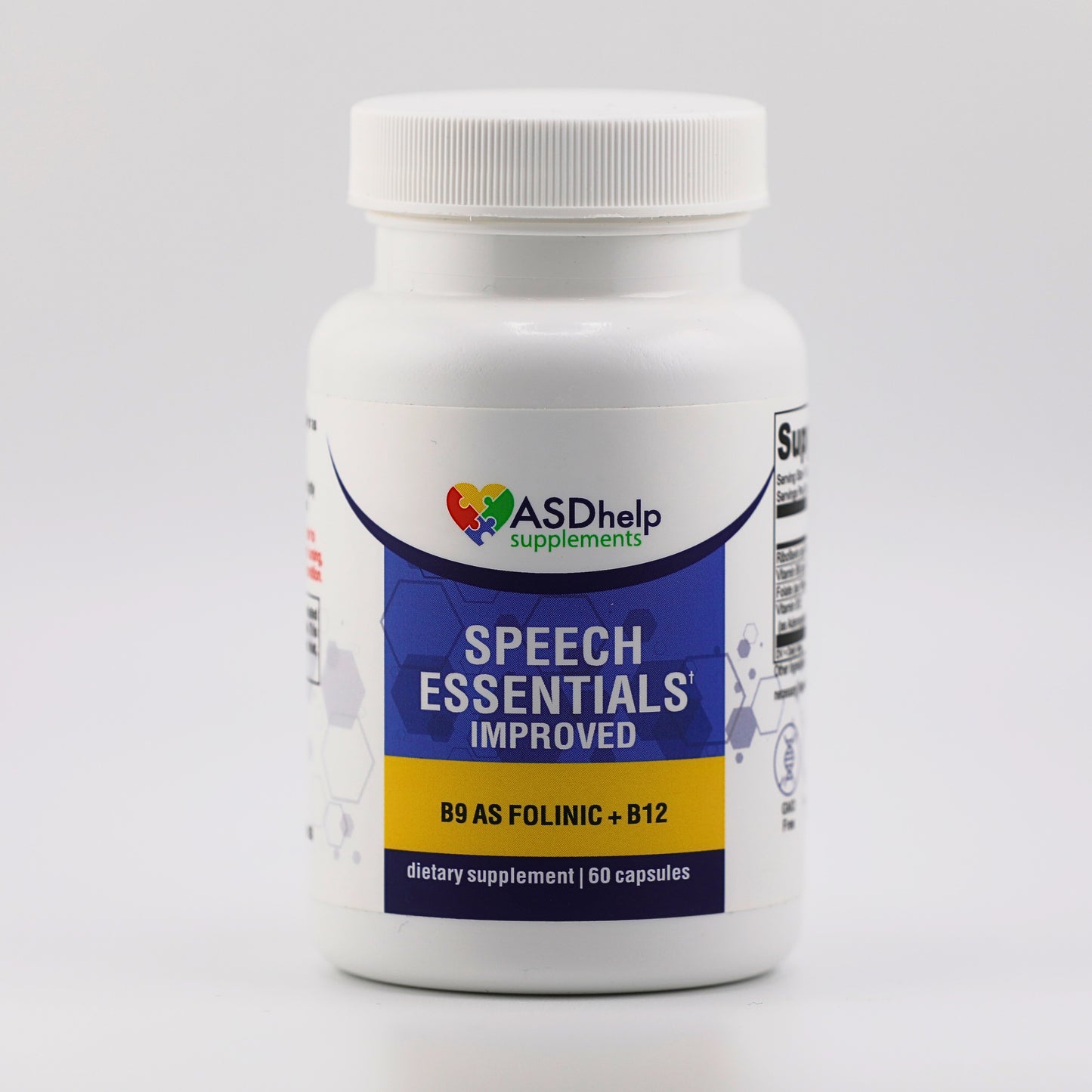
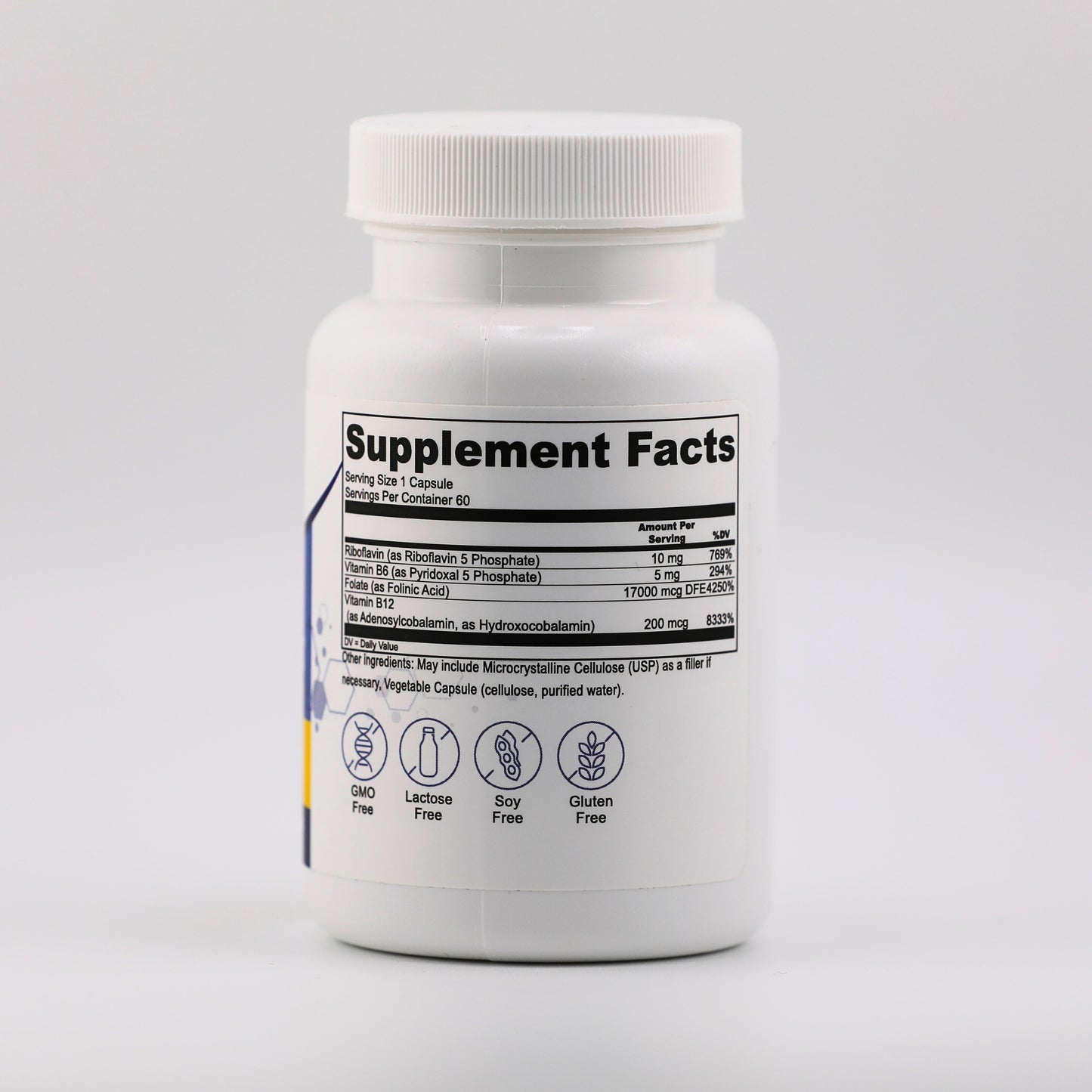
We make folinic acid supplements, so we are not neutral. Set that aside and the reasoning still holds: folinic acid is the form that skips the DHFR bottleneck, can reach the brain by a second route, and is the form the trials tested. Our Speech Essentials capsules contain 10 mg (Improved) or 12 mg (Pro) of calcium folinate with active B12; compare the two formulas.
The limits are just as real. The evidence comes from small trials, the children most likely to respond are the antibody-positive ones, and no form of folate replaces a clinician's judgment.
Questions to take to your doctor
- Which form of folate is in every product my child takes, including the multivitamin and fortified foods?
- Is it worth testing for folate receptor autoantibodies or an MTHFR variant?
- Should we reduce synthetic folic acid, and how do we do that without letting folate run low?
- Does folinic acid fit my child's situation, and at what dose?
Sources
- Frye RE et al. Folinic acid improves verbal communication in children with autism and language impairment: a randomized double-blind placebo-controlled trial. Mol Psychiatry 2018. PMID 27752075
- Rossignol DA, Frye RE. Cerebral folate deficiency, folate receptor alpha autoantibodies and leucovorin treatment in autism spectrum disorders: a systematic review and meta-analysis. J Pers Med 2021. PMID 34834493
- Frye RE et al. Treatment of folate metabolism abnormalities in autism spectrum disorder. Semin Pediatr Neurol 2020. PMID 32892962
- Ramaekers VT et al. A milk-free diet downregulates folate receptor autoimmunity in cerebral folate deficiency syndrome. Dev Med Child Neurol 2008. PMID 18355335
- Raghavan R et al. A prospective birth cohort study on cord blood folate subtypes and risk of autism spectrum disorder. Am J Clin Nutr 2020. PMID 32844208
- Wiens D, DeSoto MC. Is high folic acid intake a risk factor for autism? A review. Brain Sci 2017. PMID 29125540
- NIH Office of Dietary Supplements. Folate fact sheet for health professionals. ods.od.nih.gov
- US Food and Drug Administration. FDA approves first treatment for patients with cerebral folate transport deficiency, 10 March 2026.
- Panda PK et al., Eur J Pediatr 2024 (PMID 39243316) was retracted in January 2026 and is not cited.
These statements have not been evaluated by the Food and Drug Administration. Speech Essentials is a dietary supplement and is not intended to diagnose, treat, cure or prevent any disease. This article is educational and is not medical advice.