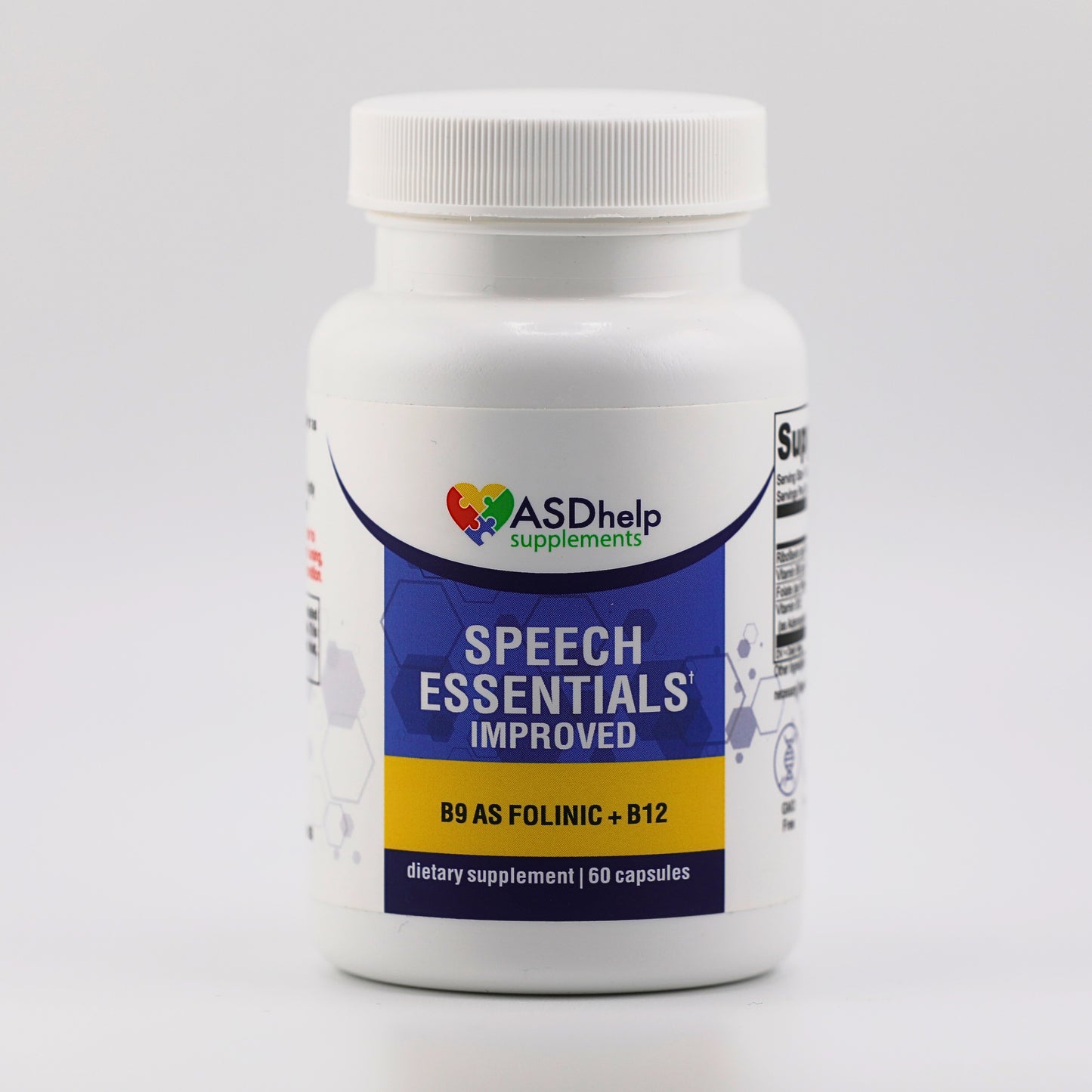
We make two folinic acid formulas that look almost identical on the shelf, and the questions we get most often are simple: what's actually different, and which one should I buy? The short answer is that they share the same core idea and the same folate compound, and they differ in four ingredients and in who they suit. The longer answer is worth reading before you spend money, because the more expensive one isn't the better one for most children.
What's the same
Both formulas are built on the same reasoning: high-dose active folate plus active B12, with no synthetic folic acid anywhere in the mix. Both use the exact same folate raw material. Folinic acid, calcium folinate, and leucovorin are three names for one molecule, and that molecule is what's in both bottles, confirmed by the maker. So neither is a different kind of treatment; they're two dose-and-cofactor arrangements of the same approach.
If you've read our other articles, this is the form with the controlled-trial evidence and the one that can take the alternate route into the brain when folate receptors are blocked. Both formulas deliver it.
Folate: same compound, a bit more in the Pro
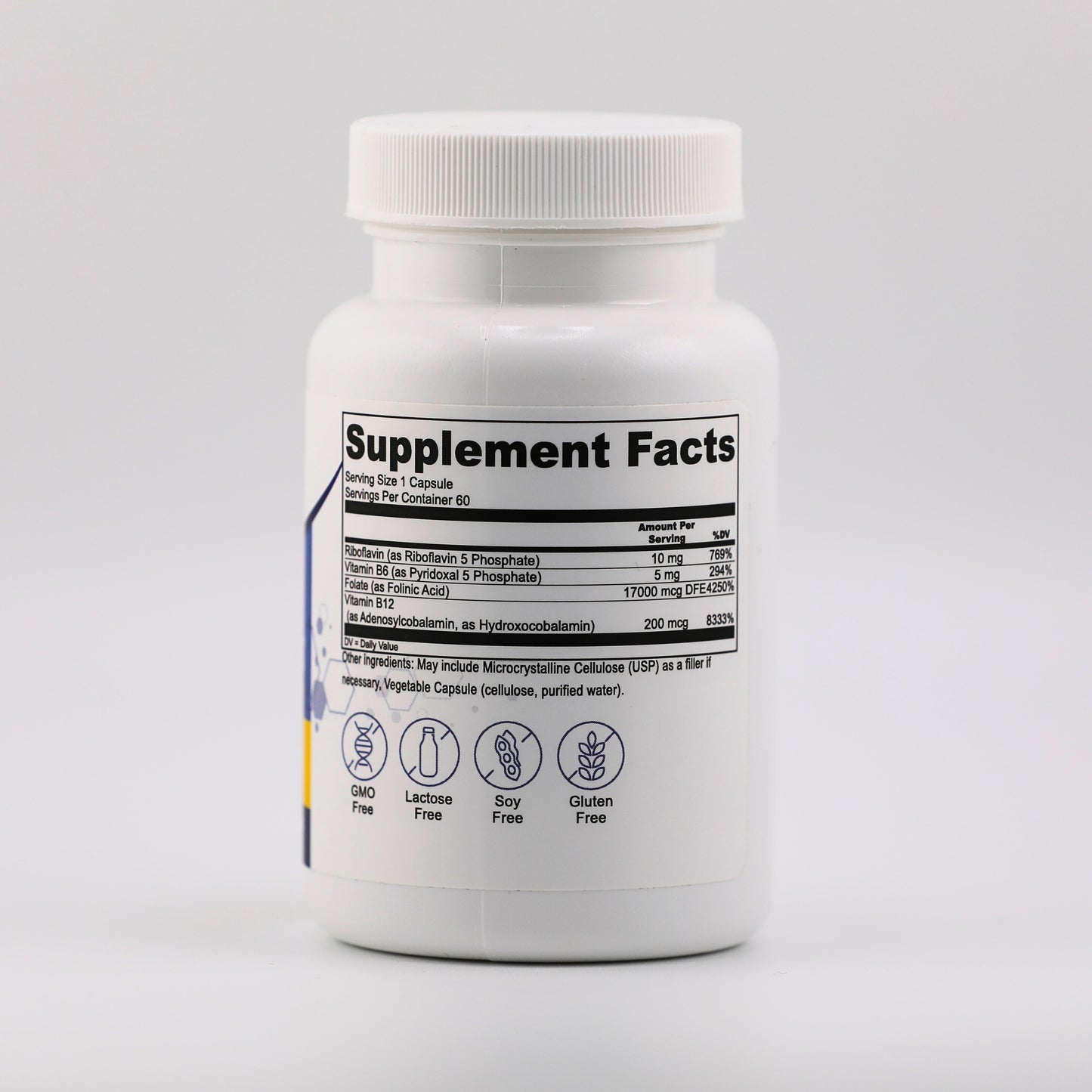
The headline difference is dose per capsule. Improved provides about 10 mg of active folinic acid per capsule (listed as 17,000 mcg DFE on the panel). Pro provides about 12 mg (20,400 mcg DFE, listed as calcium folinate), roughly 20% more.
That's not a stronger drug, it's a bigger scoop of the same one. The practical use of the higher dose is arithmetic: a heavier child aiming for a given weight-based amount reaches it with fewer capsules on the Pro. We keep the actual weight-based math off the product pages on purpose, because that calculation belongs with the clinician who knows your child's weight, labs, and other medications, not on a shelf tag.
B12: dual in Improved, single in Pro
Improved carries 200 mcg of B12 as two forms, adenosylcobalamin and hydroxocobalamin. Pro carries the same 200 mcg but as adenosylcobalamin only. Neither uses methylcobalamin.
The reasoning behind the split is real. Adenosylcobalamin covers the mitochondrial, energy side of B12. Hydroxocobalamin is the depot form: it stores well and converts slowly onward into the other active forms, including methylcobalamin, at the body's own pace. So Improved reaches the methylation pathway by conversion and covers energy at the same time, while Pro keeps a cleaner, single-form profile aimed squarely at the mitochondrial arm. If you want the broader B12 coverage, that's Improved. If you're already taking another B12 separately and want to avoid doubling up, the single form in Pro can be the tidier choice.
B6 and riboflavin: where the two really part ways
Both formulas use the active P5P form of vitamin B6, so no conversion step is needed. Improved has 5 mg, Pro has 2.5 mg. B6 is a cofactor for making serotonin, dopamine, and GABA, and it tends to run low in autistic children (Zhou 2023; Kurutas 2018). The halved dose in Pro is a deliberate simplification rather than a downgrade; 2.5 mg still supplies well above the daily value.
Riboflavin is the bigger gap. Improved includes 10 mg of active riboflavin (R5P); Pro includes none. This matters because riboflavin is the cofactor the MTHFR enzyme depends on, and MTHFR variants like C677T show up more often in autism and ADHD, reducing how well that enzyme activates folate (Andres 2023). For a child with an MTHFR variant, riboflavin isn't a bonus, it's the thing that helps the whole folate pathway run. Dropping it, as the Pro does, leaves a real hole for anyone in that group.
Who each one is for
Improved is the broader, more forgiving formula. It suits children who haven't been tested for MTHFR or folate-receptor antibodies yet, because the wider stack covers more possible gaps. It suits anyone with a known or suspected MTHFR variant, because of the riboflavin. It suits sensitive children and first-timers who want a gentler on-ramp with the dual B12. If you're not sure, this is the one designed for not being sure.
Pro is the narrower, more targeted formula. It fits a child confirmed positive for folate-receptor antibodies, where matching the clinical-trial compound closely is the goal. It fits families who want the simplest possible label so they can track the folate-and-B12 response without extra variables moving around. It fits heavier children who need more folate per capsule, and people already supplementing riboflavin or another B12 form separately who don't want to double-dose.
How we see it
We'd make more money steering everyone to the pricier bottle, so take the following as us arguing against our own margin. For most parents, the honest default is to start with Improved. It's the more complete formula, it covers the MTHFR case that you often can't rule out without testing, and its gentler B12 profile is easier to begin with. Pro earns its place when you have a specific reason for it: a confirmed antibody result, a clinician's protocol, a much larger child, or a supplement stack you're already running.
The limit applies to both, and we won't skip it. These are dietary supplements, not approved medicines; the trial evidence behind folinic acid is real but small, not every child responds, and the children most likely to benefit are the antibody-positive ones. Neither bottle changes that. Both should be used with a clinician who can test, supervise, and adjust.
What it means in practice
If you're starting out and haven't tested for MTHFR or folate-receptor antibodies, start with Improved and involve your provider. If testing has already pointed you toward a targeted, higher-folate approach, or a clinician is running a specific protocol, that's when Pro makes sense. Either way, don't guess at the dose from a label; weight-based protocols belong with the person who has your child's numbers. If you want the side-by-side laid out in one place, our formula guide walks through it.
Questions to take to your doctor
Ask whether MTHFR testing would settle the riboflavin question for your child, since that's the clearest reason to pick one formula over the other. Ask whether a folate-receptor antibody test would point you toward the targeted Pro approach or keep you on the broader Improved. Ask how to dose whichever you choose by your child's weight and labs. And ask whether anything else your child takes overlaps with the B-vitamins in these formulas, so you're not stacking the same nutrient twice.
Sources
Speech Essentials Improved and Pro Supplement Facts panels (product labels) · Andres CR et al. Nutrients 2023, PMC10048251 · Zhou N et al. Nutrients 2023, PMC10188270 · Kurutas EB 2018 · Rossignol DA, Frye RE. J Pers Med 2021, PMC8622150 · Frye RE et al. Mol Psychiatry 2018, PMC5794882. Panda PK et al. Eur J Pediatr 2024 (PMID 39243316) is retracted and is not cited.
These statements have not been evaluated by the Food and Drug Administration. Speech Essentials is a dietary supplement and is not intended to diagnose, treat, cure or prevent any disease. This article is educational and is not medical advice.